


Choosing a tablecloth looks simple until you are comparing two sizes, wondering whether 170 × 250 cm works for six or eight guests, or discovering that a beautiful cloth becomes annoying because it hangs too low over your knees. The right size starts with the real dimensions of the table, then the drop you want.
Material matters just as much. An everyday tablecloth needs to cope with repeated meals and small spills, while a table set for a celebration can focus more on texture, drape and visual impact. Here is how to choose a tablecloth by size, shape, guest count, material and everyday use.
1. Always measure the table first
Measure the top even if you know the number of seats advertised for the table. Two six-seater tables can be very different in length and width. Measure length and width for rectangular or square tables, and diameter for round tables.
If your table has an extension leaf, measure it fully extended too. A tablecloth that looks perfect every day may become far too short as soon as two extra guests arrive.
2. The simple formula: table size + twice the drop
The drop is the part of the cloth that hangs over each edge. To find a target size, add twice the desired drop to the table dimensions.
- Rectangular table: cloth length = table length + 2 × drop; cloth width = table width + 2 × drop.
- Square table: use the same calculation on both sides.
- Round table: cloth diameter = table diameter + 2 × drop.
Example: for a 160 × 90 cm table with a 25 cm drop, look for a cloth close to 210 × 140 cm. For a 120 cm round table with the same drop, the target diameter is around 170 cm.
3. How much drop should you allow?
There is no single correct answer. The best drop depends on how formal you want the table to look and how it is used.
- 15 to 20 cm: short and practical, useful for small tables and everyday meals.
- 20 to 30 cm: an easy everyday balance, decorative without getting in the way.
- 30 to 40 cm: more generous and formal, suitable for larger tables and special dinners.
- Almost to the floor: mainly for styled events, buffets, weddings or specific decorative effects.
For a family table used every day, we usually prefer a drop that looks generous but does not need constant adjustment whenever somebody sits down.
4. Guest count is a guide, not the measurement
Around 55 to 60 cm of table edge per person is often used as a comfortable planning guide. It helps estimate how long a table needs to be, but chair width, table legs and serving dishes can change the real space available.
- 2 to 4 people: often compact square, round or rectangular tables; measuring is essential to avoid an oversized cloth.
- 4 to 6 people: many tables fall around 120 to 160 cm long, but proportions vary considerably.
- 6 to 8 people: many tables are around 160 to 200 cm long; remember to check width as well.
- 8 to 10 people: tables often exceed 200 cm and may need a large cloth or a size designed for extension tables.
- 10 or more: always measure the table in its fully extended configuration.
Guest count is therefore a useful check, not the main formula. A tablecloth should ultimately be chosen in centimetres.
5. Practical calculation examples
- 120 × 80 cm table with 20 cm drop: target around 160 × 120 cm.
- 140 × 80 cm table with 25 cm drop: around 190 × 130 cm.
- 160 × 90 cm table with 25 cm drop: around 210 × 140 cm.
- 180 × 90 cm table with 30 cm drop: around 240 × 150 cm.
- 200 × 100 cm table with 30 cm drop: around 260 × 160 cm.
- Round table Ø120 cm with 25 cm drop: round cloth Ø170 cm.
- Round table Ø140 cm with 20 cm drop: round cloth Ø180 cm.
Ready-made tablecloths do not always match these exact target dimensions. If you are between two sizes, calculate the real drop each option will create rather than automatically buying the larger one.
6. Can a rectangular cloth go on a square or round table?
A rectangular cloth can work on a square table if the proportions still feel balanced, although the drops will differ. On a round table, a square cloth can create an attractive four-point effect, while a round cloth gives a more even outline.
For a table used every day, matching the cloth shape to the tabletop is normally the easiest solution. For a special occasion, you can be more creative.
7. Which material is best for everyday use?
For a family dining table, start with care requirements. Daily meals bring spilled drinks, tomato sauce, snack-time chocolate and crumbs. A beautiful cloth that is too demanding often ends up staying in the cupboard.
Cotton
Cotton is easy to understand and pleasant on the table. It has a genuine textile look, comes in many colours and can work for both everyday meals and more formal settings depending on the weave.
Recycled cotton
Recycled cotton keeps a textile feel while giving existing fibres a second life. Collections such as Delia, Grace and Yuna offer several sizes and colours with a warm, relaxed appearance.
Cotton and polyester blends
A blend can add stability or make some everyday uses easier depending on how the fabric is constructed. Delia, for example, combines recycled cotton and polyester.
Cotton gauze
Softer and more textured, cotton gauze creates an informal, welcoming table. Its naturally crinkled surface means you do not need to chase a perfectly pressed look. The Gaïa round tablecloth is a good example.
Coated tablecloths
For a table used several times a day, a coating can be very practical because small splashes can be wiped quickly. The Yuna coated recycled tablecloth keeps a textile appearance while making everyday care easier.
Tablecloths for different lifestyles
You can choose a tablecloth for its simplicity, pattern, material or easy care. These four options show different approaches.
-

Delia recycled tablecloth
From 39.90 € -
Grace recycled tablecloth
From 26.90 € -
Erina Multico recycled tablecloth
From Original price was: 39.90 €.19.90 €Current price is: 19.90 €. -
Yuna recycled coated tablecloth
From 43.90 €


8. For special occasions, drape and texture matter more
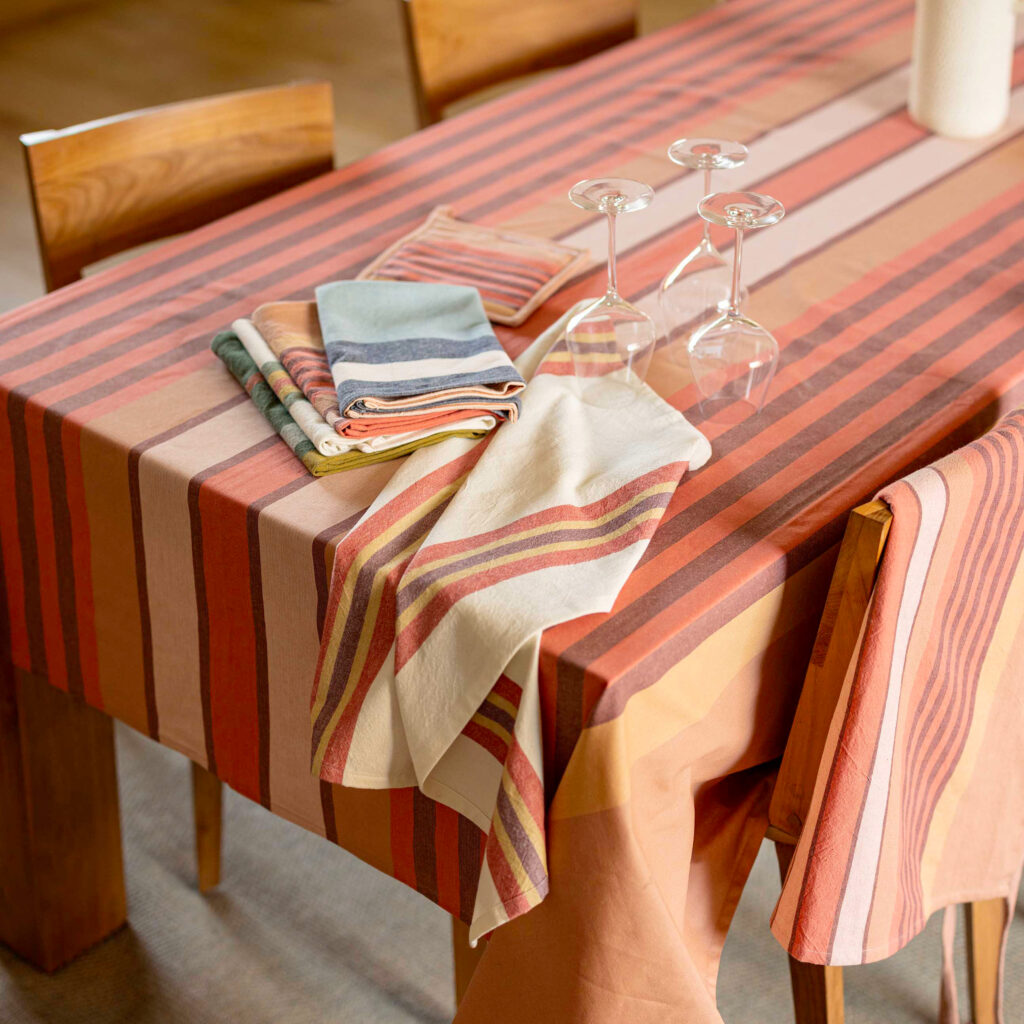
For Christmas, birthdays or dinners where the table becomes part of the decoration, you can choose a slightly deeper drop and a more expressive fabric.
A plain cloth makes it easy to highlight beautiful plates, candles and a centrepiece. A striped or graphic cloth can become the main decorative statement; in that case, keep tableware and napkins calmer.
9. Light, dark or patterned tablecloth?
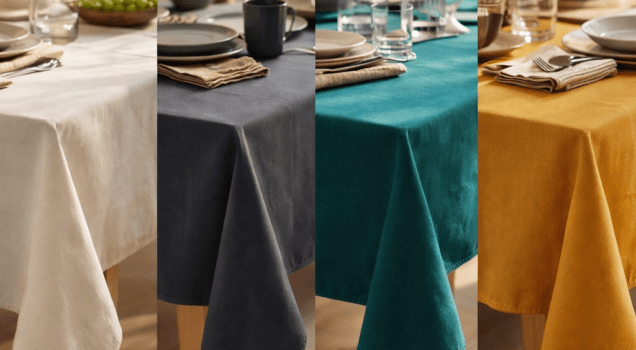
A light cloth adds brightness and gives you plenty of freedom with dishes. Ecru, ivory, natural and sand tones are easy to update from season to season.
Deeper colours such as green, peacock, terracotta or darker neutrals add immediate character. Stripes and bold patterns need fewer extra decorative elements.
If you enjoy changing the table often, a plain base is especially versatile: simply swap napkins, flowers, candles or tableware.
10. Napkins can change the mood without changing the cloth
Table napkins are an easy way to add a second colour or repeat a shade already present in the room. They do not have to match the tablecloth exactly.
On a natural cloth, try green, terracotta or burgundy napkins. With stripes, pick one colour from the pattern. With a colourful cloth, return to a quieter plain napkin.
Shapes and accessories to complete the table


11. What if the table has extension leaves?
This is one situation where owning two tablecloth sizes can make sense. A smaller cloth suits the table when closed, while a larger one can wait for dinners when the extension is in use.
If you prefer to own only one cloth, choose for the configuration you use most often. A cloth that is excessively long every day is less pleasant even if it becomes perfect three times a year.
12. Should you use a table protector underneath?
A table pad or protector can help shield the surface from liquids, moderate heat and small knocks. It may also make the tablecloth feel softer and reduce slipping.
Choose a protector compatible with the tabletop material and follow the table manufacturer’s advice, especially on lacquered, varnished or moisture-sensitive surfaces.
13. How to avoid a cloth that is too long or too short
- Measure the tabletop and keep the dimensions in your phone.
- Calculate the real drop for every size you are considering.
- Remember the thickness of the tabletop and any rails underneath.
- Check that the cloth will not rest heavily on your knees when seated.
- If the table extends, calculate both configurations.
14. How to care for a tablecloth
Always start with the care label. Two tablecloths that look similar may require different washing. Deal with stains quickly without aggressive rubbing and never leave a damp cloth folded in a laundry basket.
Mamimosa always reminds us that a fresh stain is usually much easier to manage than one that has dried. Wash coloured cloths with similar colours and respect the temperature recommended by the manufacturer.
For more help, see our linen care guide and care label guide.
15. Our five-step tablecloth method
- 1. Measure the table in the configuration you actually use.
- 2. Choose the drop: short and practical, balanced, or more formal.
- 3. Calculate target dimensions using table size + 2 × drop.
- 4. Choose material according to real life: easy care, texture, occasion or coating.
- 5. Finally, choose colour and accessories in relation to tableware and the room.
This order prevents you from buying a cloth purely because you love the colour, only to find that it is too short, too long or too demanding to use.
You may also like
- Autumn-winter 2026 décor trends: colours and textiles to warm up the home
- Why should you always wash new linen?
What if the exact calculated size does not exist?
This happens very often. Ready-made tablecloths are produced in standard formats, while dining tables come in an enormous variety of sizes. The useful question is not therefore “Do I have the exact target size?” but “What drop will each available size create on my table?” Take the difference between the cloth and the tabletop, divide it by two, and you immediately know how far it will hang on each side.
If one option gives 18 cm and the next gives 33 cm, choose according to your use. The shorter option will feel lighter and more practical; the larger one will look more generous and formal. There is no reason to reject either if the proportions work with your chairs and table legs.
Should you own one tablecloth or several?
A single versatile tablecloth can be enough if your table rarely changes size. Choose a calm colour, a material you are happy to wash regularly and a drop that works for both weekday meals and guests. You can then change the atmosphere with napkins, flowers, candles and tableware rather than replacing the main cloth.
Two tablecloths become useful when the table is frequently extended, when everyday meals require easy care but celebrations call for a more decorative textile, or when you enjoy changing the room with the seasons. In that case, give each cloth a clear purpose instead of collecting several nearly identical sizes.
How to style the table without overcrowding it
Once the tablecloth is chosen, leave it enough visual space. If it is patterned, the simplest approach is often plain napkins and uncomplicated dishes. If it is plain, you can introduce a patterned napkin, coloured glassware or a stronger centrepiece. Try to keep one element as the main feature rather than asking the cloth, plates, flowers and candles to compete at the same time.
Remember that a table is also a place to pass dishes, bread and water. A beautiful setting still needs free space. For a family meal, comfort usually matters more than adding one final decorative object.
How to store tablecloths between meals
Store a tablecloth completely dry and clean. Folding it while slightly damp can encourage marks and odours, especially if it stays in a closed cupboard for weeks. Large cloths are often easier to manage when folded along the same lines each time, without crushing them under heavy linen.
If you only use a formal tablecloth occasionally, check it a few days before the event rather than on the morning itself. That leaves time to wash, air or lightly iron it according to the care label.
FAQ: choosing the right tablecloth
How much drop should a tablecloth have?
For everyday use, around 20 to 30 cm on each side is often comfortable. A shorter drop is very practical, while 30 to 40 cm gives a more formal look.
What size cloth for a 160 × 90 cm table?
With a 25 cm drop, the target size is around 210 × 140 cm. If that exact size is unavailable, calculate the drop created by the closest ready-made options.
What size tablecloth for six people?
Guest count alone is not enough. Measure the actual table because six-seater tables vary greatly, then add the drop you want.
Should a tablecloth touch the floor?
No. For daily use it is usually inconvenient. Floor-length cloths are mainly used for events, styled buffets or specific decorative effects.
Which tablecloth material is most practical?
For everyday use, choose according to washing habits and frequency. Coated cloths are useful against splashes, while cotton and recycled cotton provide a more traditional textile feel.
Can a square tablecloth be used on a round table?
Yes. It creates four decorative points, while a round cloth gives a more even and traditional outline.


Leave a Reply