


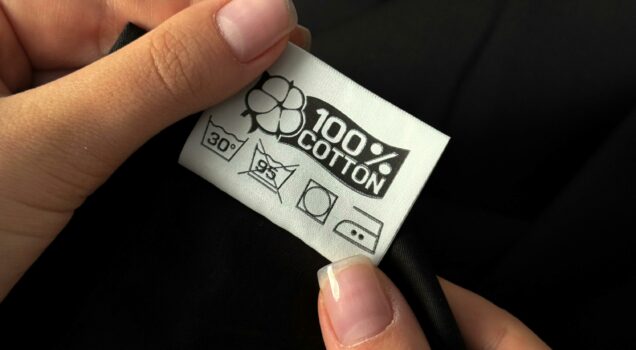
When I bought my first sheets for Anna, I was at a loss when I saw all those strange little symbols on the labels. Triangles, circles, basins of water… It was like a real secret language! Fortunately, Mamimosa quickly taught me how to read them. And believe me, it makes all the difference: understanding care labels is the key to keeping your clothes beautiful, soft and comfortable for longer.
Why labels are essential
Sometimes you want to cut off those itchy labels… but they’re precious! They give us all the information we need to avoid unpleasant surprises:
- A sheet that shrinks with the first wash.
- A duvet cover whose colours fade too quickly.
- Or worse, a fabric that warps after being tumble-dried.
By following these guidelines, you can extend the life of your textiles, while retaining the cocooning comfort we love so much.
Deciphering the most common symbols on care labels
Manufacturers use a universal language of small pictograms. Here are the ones you’re most likely to come across:
- Washing 🫧 : a basin of water.
- A number (30, 40, 60…) indicates the maximum temperature.
- One-handed → hand washing recommended.
- A cross → do not wash at all (dry clean only).
- Drying ☀️: a square with a circle in it.
- Dots inside → dryer heat level (1 = gentle, 2 = normal).
- Cross → tumble dryer prohibited.
- Ironing 🪡: an iron.
- One stitch = gentle ironing.
- Two points = medium heat.
- Three points = high heat.
- Cross → ironing prohibited.
- Money laundering ◻️: a triangle.
- Empty = authorised.
- With cross = prohibited.
- With two dashes = chlorine-free products only.
- Dry cleaning ⚪: a circle, sometimes with a letter (for dry cleaners).
Mamimosa’s practical advice
- Always wash new clothes before using them. “That’s how it gets really soft,” she says. We’ve already written an article on the subject.
- Don’t overload your machine, the linen must have room to spin properly.
- For delicate textiles (cotton gauze, fine linen), use a washing net.
- Dry preferably in the open air, to keep your clothes smelling fresh and natural.
- Fold and store your sheets in a dry place to avoid dampness and odours.
A closer look at some of the materials used in the home
- Cotton: tolerates regular washing very well, but prefer 40° to preserve its softness.
- Cotton gauze: a light, delicate fabric, wash gently at 30°.
- Washed linen: it softens over time, so avoid tumble-drying it too hot.
- Jacquard: a precious weave, wash inside out to protect the patterns.
Conclusion
Reading a care label isn’t so complicated after all. And by following these little symbols, your clothes will keep their beauty and comfort, wash after wash.
Because you deserve it, turn your time at home into moments of true well-being… and discover our selection of household linen designed to last and easy to care for.


Leave a Reply